Categories
Discipline Faith Thinking

How to Stay Disciplined as a Christian

Staying disciplined as a Christian sounds simple in theory—but in practice, it’s one of the hardest things to maintain. You start with good intentions, but consistency fades, motivation drops, and routines break.

I’ve experienced this myself, especially when trying to balance prayer, fasting, work, and daily responsibilities. What I’ve learned is this: discipline isn’t built through intensity—it’s built through repetition.


Start Small (Daily Prayer Habit)

One of the biggest mistakes I made was trying to do too much too quickly. I would plan long, structured prayer sessions, but I couldn’t sustain them.

What actually helped was starting small.

Instead of aiming for long periods, I focused on simple, repeatable practices:

  • The Rosary (1 decade of the Rosary = 1 x Our Father, 10x Hail Marys and 1 x Glory Be) gave me structure and helped me stay focused. I would start with 1-2 decades of the Rosary
  • The Jesus Prayer allowed me to pray throughout the day, even briefly
  • Sometimes, I would just sit in silence for one minute to reset my thoughts

These small steps were far more sustainable than trying to force long, intense sessions.

The types of prayers I use:


Remove Distractions

I realised quickly that discipline isn’t just about what you add—it’s also about what you remove.

My biggest distractions weren’t just external, like my phone, but internal—overthinking, frustration, and mental fatigue.

To deal with this, I made simple changes:

  • Putting my phone away during prayer
  • Choosing a quiet space
  • Keeping my prayers simple instead of overcomplicating them

Discipline becomes much easier when you reduce the things that constantly pull your attention away.


Stay Consistent, Not Perfect

There were many days when I didn’t feel spiritually strong. Sometimes I felt mentally drained, especially during fasting or after long days of work.

But I started to understand something important: discipline is not about how you feel—it’s about whether you show up.

On different days, I used different approaches:

  • Sometimes the Trisagion
  • Sometimes a short prayer
  • Sometimes just silence

What mattered wasn’t the intensity—it was the consistency.

Even when it felt like nothing was happening, showing up daily built a habit over time.


Why This Matters

Christian discipline isn’t about becoming perfect overnight. It’s about slowly forming habits that shape your life.

Small, consistent actions:

  • Strengthen your focus
  • Build spiritual awareness
  • Help you stay grounded even when life feels difficult

Conclusion

If you’re struggling with discipline, don’t aim for perfection—aim for consistency.

Start small. Remove distractions. Keep showing up.

Because in the end, discipline doesn’t grow through intensity—it grows through repetition.

Categories
Faith

Is Christianity Logical or Blind Faith?

Icon of a human head silhouette with a thought bubble containing a cross, symbolising spirituality or faith.

Introduction
Many people assume Christianity is based purely on blind faith—but is that actually true?

The Misconception
Faith is often misunderstood as believing without evidence. But in Christianity, faith is better understood as trust based on reason.

The Rational Case

  • The universe had a beginning → suggests a cause (see St. Thomas Aquinas’ concept of God as the Unmoved Mover in his work, Summa Theologica. Everything in creation seems to follow a design from the nuclear and electron orbital structure of the atoms, the way the human body is designed with its various specialised organs, the Universe consisting of many galaxies etc.)
  • Objective morality exists → suggests a moral lawgiver (most sane and sensible people would know that murder and stealing is wrong by what they feel and/ or what their logic tells them so it implies there is a universal standard of behaviour common to all cultures and this in-built sense of right and wrong strongly implies a moral lawgiver imprinted this in all humans)
  • Human consciousness → points beyond materialism (ever get that feeling of something other-worldly, sacred and indescribable when you step into a beautiful church or marvel at beauty of creation when you walk on a mountain? That’s called the numinous feeling and this phrase was coined by the theologian Rudolf Otto.)

Conclusion
Christianity isn’t anti-intellectual—it invites deep thinking. Faith and reason are not enemies. Reason can act as a gateway to the existence of God but faith completes our understanding of God.

Categories
Science Revision

Osmosis Explained Simply (GCSE Biology)

Definition of osmosis:

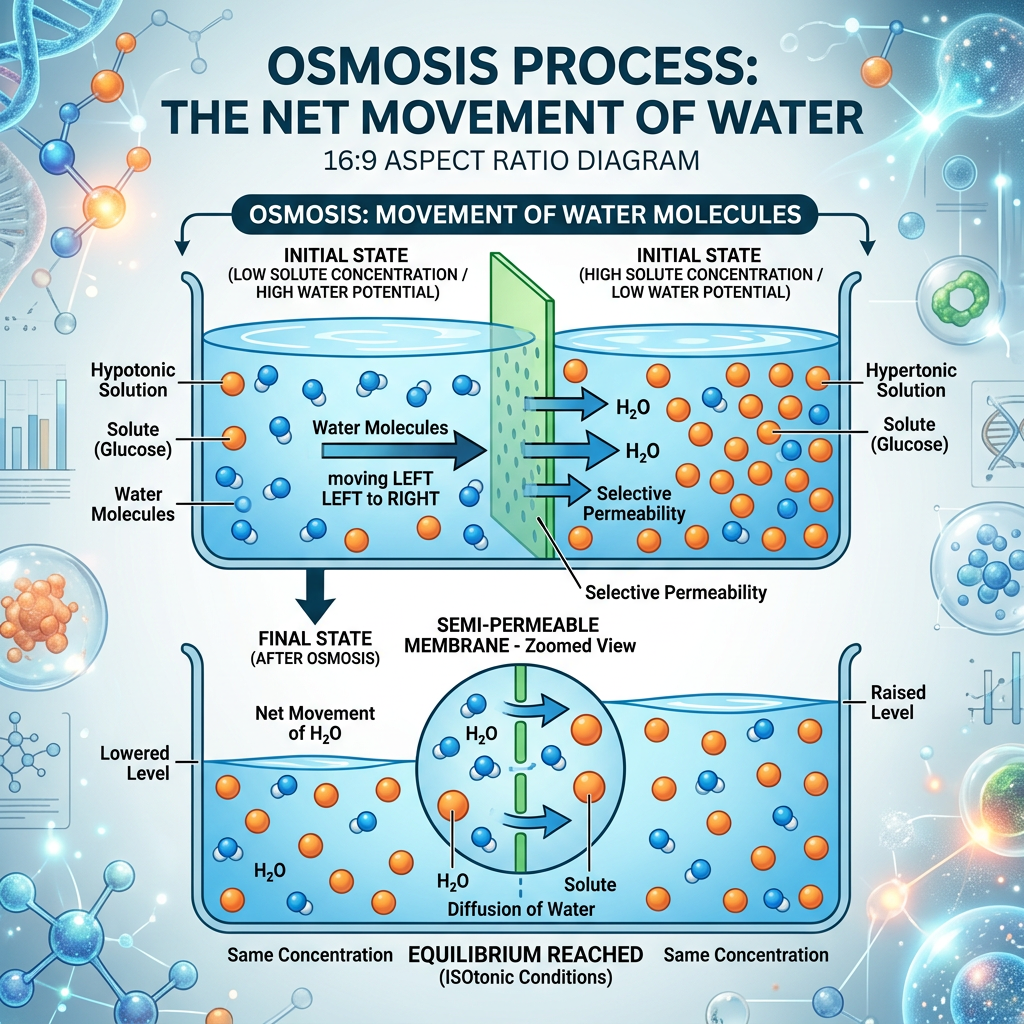
Osmosis is the diffusion of water molecules from a region, where the water molecules are at a higher concentration, to a region where they are at a lower concentration, through a partially permeable membrane.

Illustration of osmosis demonstrating a semi-permeable membrane separating two solutions with different concentrations of particles.

Diffusion vs osmosis:

Osmosis and diffusion are similar in some ways and different in other ways.

OsmosisDiffusion
Osmosis requires a partially permeable membraneDiffusion doesn’t require a partially permeable membrane
Involves water molecules moving from a region of higher water concentration to a region of lower water concentration through a partially permeable membraneInvolves ions, atoms and molecules moving from an area of higher concentration to an area of lower concentration
Occurs in liquids (water)Occurs in solids, liquids and gases
Is a passive process (doesn’t require energy)Is a passive process (doesn’t require energy)
The concentration of the solvent doesn’t become equal on both sides of the partially permeable membrane.The concentration of the diffused molecules becomes distributed equally in a given space.

Plant cells vs animal cells in osmosis:

Diagram illustrating the effects of hypotonic, isotonic, and hypertonic solutions on animal and plant cells. Hypotonic solution shows a lysed animal cell and a turgid plant cell. Isotonic solution shows a normal animal cell and a flaccid plant cell. Hypertonic solution shows a shriveled animal cell and a plasmolyzed plant cell.

When animal cells are placed into solutions with varying solute concentrations, the animal cells will either:

  • expand in size, gain water and eventually burst in distilled water or more dilute (hypotonic) solutions

or

  • lose water and shrink in more concentrated (hypertonic) solutions

With plant cells, they have a cell wall which is strong and prevents the plant cell from bursting.

When plant cells are placed into solutions with varying solute concentrations, the plant cells will either:

  • expand in size, gain water and the vacuole and the cytoplasm will push against the cell wall when the plant cell is placed in distilled water or more dilute (hypotonic) solutions; the plant cell becomes turgid

or

  • lose water and shrink in more concentrated (hypertonic) solutions. The cell contents pull away from the cell wall and the plant cell becomes flaccid.

AQA GCSE Bio Exam questions:

An exam paper page for science students detailing a student's investigation on the effect of salt solution concentrations on uncooked potato mass, including method steps and questions.
A table showing results of an experiment measuring the mass change of potato pieces in various concentrations of salt solution, along with possible apparatus and resolution options.
An exam paper page showing calculations related to changes in mass, data presentation options (bar chart, line graph, pie chart), and fill-in-the-blank sentences about potato cell properties.

Reference:

1.3 Transport in Cells (F) QP.pdf

AQA GCSE Bio Exam answers:

Image of a mark scheme for a science examination question on potato experiments involving transport in cells, detailing guidelines and criteria for grading answers.
A segment of a worksheet on cell transport, listing key concepts related to water, osmosis, and membrane permeability, with specific instructions for answers in a defined range.

Reference:

1.3 Transport in Cells (F) MS.pdf

Categories
Science Revision

The Reactivity Series Explained (GCSE Chemistry)

What the reactivity series is:

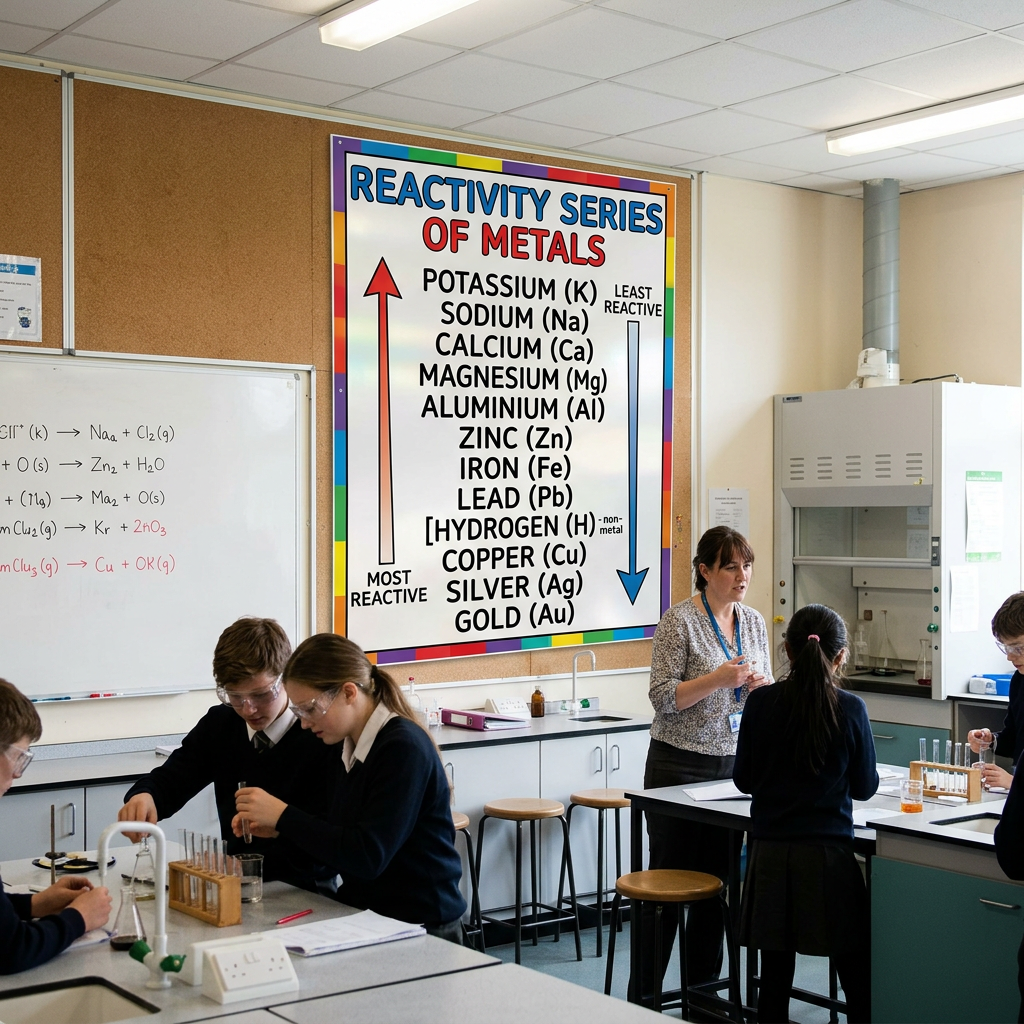
The reactivity series of metals is a chart showing how reactive metals are, with the least reactive metals placed at the bottom of the chart and the most reactive metals placed at the top.

A table outlining the reactivity of various metals with cold water and dilute acids, indicating the reaction types and their reactivity levels from most to least reactive.

Why metals react differently:

The reactivity of a metal is determined by how easily the metal loses electrons; the more easily a metal loses electrons, the higher up it is placed in the Reactivity series table.

Memory tricks for remembering the reactivity series:

There are a variety of ways to remember the reactivity series, one way being the use of mnemonics:

Please Stop Calling Me A Zebra, I Like Her Calling Me Smart Goat

Penguins Swim Like Crazy, Making A Zoo ICold, Snowy Greenland”

Displacement reactions

Example 1:

For the following reaction, we need to decide if the magnesium and copper atoms swap places when magnesium metal strips are added to a blue copper sulphate solution:

Mg (s) + CuSO₄ (aq) →

magnesium + copper sulfate →

Chart illustrating the reactivity of various metals, with potassium at the top as the most reactive and gold at the bottom as the least reactive.

Since the magnesium is above the copper on the metal reactivity series table, magnesium is more reactive than copper so this means the magnesium atoms (Mg0) release 2 electrons to become completely dissolved in solution and become Mg2+ ions that bond with the water (H2O) and SO₄2- ions while the copper ions (Cu2+) accept the 2 electrons and become copper metal (Cu0) which drops at of solution and forms at the bottom (see the equation below):

Mg (s) + CuSO₄ (aq) → Cu (s) + MgSO₄ (aq)

magnesium + copper sulfate → copper + magnesium sulfate

Additionally, you will start to notice the blue copper sulfate solution starts getting paler when magnesium strips are added to the solution until you get a transparent magnesium sulfate solution.

Example 2:

The following is an example of the highly exothermic Thermite reaction where iron (III) oxide reacts with fine aluminium powder to produce iron and aluminium oxide

Fe2O3 + 2Al → 2Fe + Al2O3

iron(III) oxide + aluminium → iron + aluminium oxide

WARNING: don’t attempt the Thermite experiment unless you have proper scientific lab training, understand the health and safety aspects of this experiment, understand proper chemical disposal procedures, undertaken risk assessments etc.

A vertical chart displaying metals arranged by reactivity, with the most reactive metals listed at the top, including potassium and sodium, and the least reactive, such as lead and copper, at the bottom. The image indicates which metals can be extracted using carbon and which cannot.

This experiment proceeds because iron is below the aluminium in the reactivity series so the aluminium atoms (Al0) lose 3 electrons to become Al3+ and the Fe3+ ions in Fe2O3 accepts the 3 electrons to form iron metal (Fe0). The Fe3+ ions in Fe2O3 are swapped by the Al3+ ions to form Al2O3.

Exam questions:

An examination paper titled 'Reactivity of Metals (F)' with questions related to the reaction between zinc and copper sulfate solution. The first question asks for the type of reaction and includes answer options: combustion, decomposition, and displacement. The second part requires the calculation of the percentage by mass of copper in copper sulfate, providing relative atomic and formula mass values.
A GCSE exam paper question focusing on electrolysis and the extraction of metals, including a table for products of electrolysis and a chemical equation to balance.
A worksheet page showing a chemistry question about calculating the relative formula mass of aluminium oxide (Al2O3) and a reactivity series of metals including potassium, lithium, carbon, zinc, tin, and gold, along with extraction methods.
A worksheet question on displacement reactions, specifically focusing on the extraction of iron from iron oxide using carbon. It includes parts for balancing a chemical equation, explaining the reduction of iron oxide, and calculating the relative formula mass of Fe2O3.
A chemistry exam paper displaying a question about the reactivity of metals, including a chemical reaction involving copper oxide and hydrogen, calculations for percentage atom economy, and an investigation of four different metals by a student.
A table displaying the reactivity results of four metals (A, B, C, D) with various metal sulfate solutions, indicating whether displacement reactions occurred.
An educational worksheet on the reactivity of metals with hydrochloric acid, featuring a diagram (Figure 1) illustrating the rate of bubbling in test tubes labelled A, B, C, and D.

Reference: AQA GCSE Chemistry Topic 4: Chemical Changes Revision – PMT

Exam answers:

A document displaying a mark scheme for a science question, detailing calculations involving displacement, percentage, volume of copper sulfate, mass, temperature change, concentration, line of best fit, and characterizing a reaction as endothermic.
An educational chemistry exam question on the reactivity of metals, including sections on molten compounds, electrolytic products, and calculations related to aluminium oxide.
An examination question page detailing chemical reactions and calculations, including equations, explanations of concepts like oxygen loss, atom economy, and reactivity of metals.
A diagram and text layout for an exam question on reactivity of metals, including pH levels and corresponding universal indicator colours. The layout includes sections labelled (a) to (f), asking for specific chemical reactions and items such as 'neutralisation' and 'burette'.
Categories
Science Revision

Electrolysis Explained for GCSE Students

Definition of electrolysis

Electrolysis is the breaking down of an electrolyte using an applied electric current.

An electrolyte is an ionic substance that has been dissolved in a solvent or has been melted.

Electrolysis of molten compounds

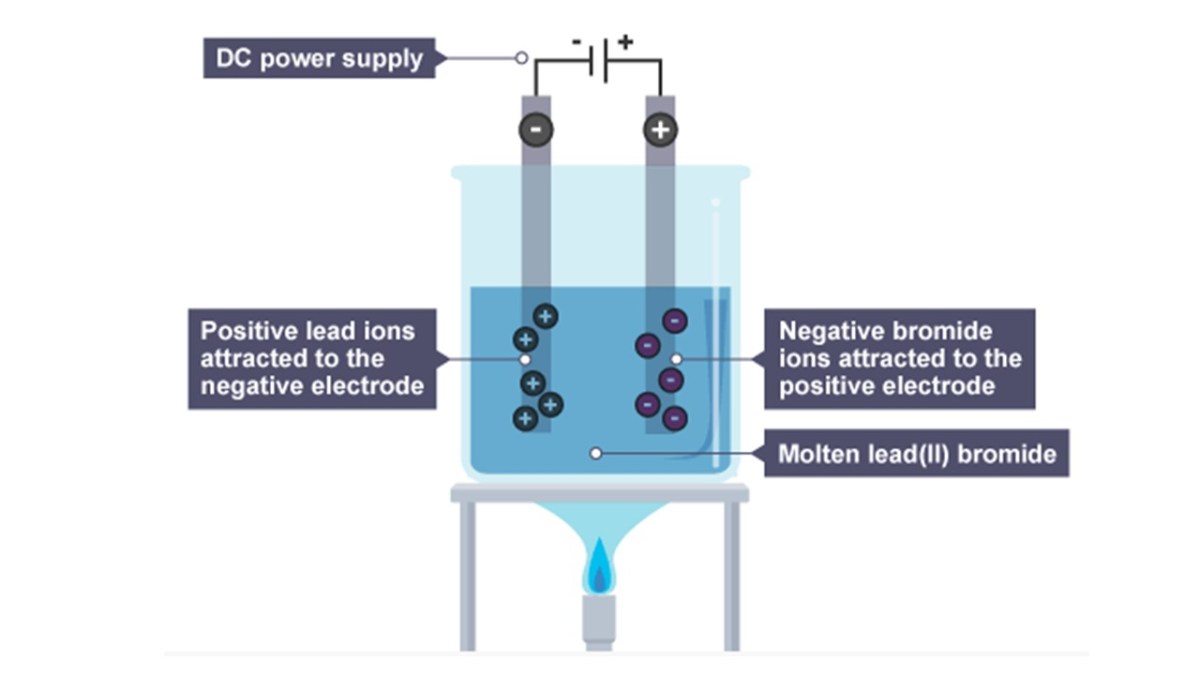
The ionic compound is heated to a very high temperature until it reaches liquid state. The metal cations are positively charged metal ions. They will move towards the negatively charged electrode, called a cathode. These ions become metal atoms at the cathode.

The non-metal anions are negatively charged ions. They will move towards the positively charged electrode, called an anode. These ions become non-metal atoms at the anode.

Fig.1 – electrolysis of molten lead (II) bromide

Diagram showing the electrolysis of molten lead(II) bromide, including a DC power supply, positive lead ions attracted to the negative electrode, and negative bromide ions attracted to the positive electrode.

Electrolysis of aqueous solutions

The ionic compound is dissolved in water. In water, there are H+ and OHions existing and they will compete with the metal cations and non-metal anions.

Fig.2 – electrolysis of aqueous copper sulfate

Diagram illustrating a copper electrolysis setup showing an anode, cathode, and copper(II) sulphate solution, with reactions for oxygen gas production and copper metal deposition.

Half-equations explained

To figure out what is produced at the cathode (negative electrode) and at the anode (positive electrode), follow the two rules below:

Rule 1: At the cathode, check the reactivity of the metal ion. If it is more reactive than hydrogen, the hydrogen ions are reduced to form a hydrogen molecule.

Chart showing metals arranged by reactivity, from most reactive potassium at the top to least reactive gold at the bottom.

Rule 2: At the anode, the anions are oxidised in the following order:

Halide ion > hydroxide ion > all other negatively charged ions

Table showing negative ions from electrolytes and the corresponding elements released at the anode.

If there are no halide ions present to be oxidised at the anion, then the hydroxide ions are next to be oxidised and the following half-equation describes what happens to the hydroxide ion that is oxidised at the anode:

4OH→ 2H2O + O2 + 4e

Practice questions

A worksheet on electrolysis and metal extraction, featuring multiple choice and table completion questions about molten substances, electrode products, and balancing a chemical equation.
A chemistry exam question focusing on the calculation of the relative formula mass of aluminium oxide and a diagram illustrating the reactivity series of metals, including potassium, lithium, carbon, zinc, tin, and gold, with instructions for predicting extraction methods.

Source for Questions papers and Answers:

AQA GCSE Chemistry Topic 4: Chemical Changes Revision – PMT

Answers to practice questions:

A mark scheme for an exam question on electrolysis, detailing the movement of ions, products at electrodes, and calculations related to electrochemical processes.
Categories
Science Revision

Ionic vs Covalent bonding Explained

What is ionic bonding?

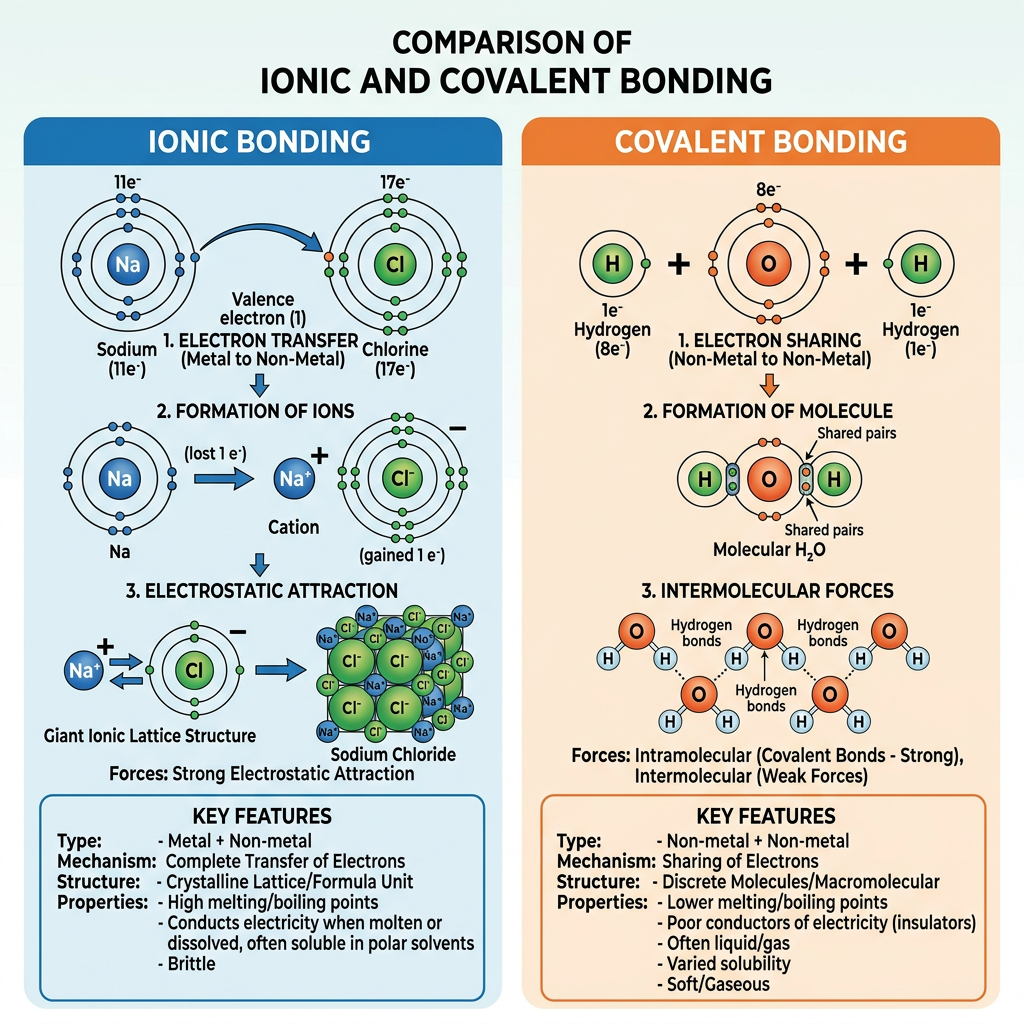
Ionic bonding is the strong electrostatic force of attraction between oppositely charged ions. Ions are formed when atoms gain electrons or lose electrons.

When atoms gain electrons, they become negatively charged particles or ions; these ions are called anions.

When atoms lose electrons, they become positively charged particles or ions; these ions are called cations.

Fig.1 – diagram shows ionic bond formation between Lithium and Fluorine ions. The Lithium ion forms when the Lithium atom loses 1 electron. This electron is given to the Fluorine atom. As a result, the Fluorine atom becomes a Fluorine ion.

Illustration showing the formation of lithium fluoride (LiF) from lithium (Li) and fluorine (F) atoms. The top section depicts the atomic structure of Li and F, while the bottom section displays the resulting Li+ and F- ions.

What is covalent bonding?

A covalent bond is formed when two non-metal atoms share a pair of electrons. The shared electrons would usually be in the outer shells of the atoms.

Fig.2 – diagram shows covalent bond formation between two hydrogen atoms where each hydrogen atom shares a pair of electrons. A hydrogen molecule, H2 , is formed.

Diagram illustrating the formation of a hydrogen molecule (H2) from two hydrogen atoms, showing atomic structure and bonding.

Key differences between ionic and covalent bonding

Comparison table of ionic and covalent bonding characteristics.

Practice questions

A worksheet page from a chemistry resource discussing methane and buckminsterfullerene, with questions about their properties and structure.
An educational image showing the structure of graphite with carbon atoms linked in a diagrammatic form and a question about the number of covalent bonds each carbon atom forms.
Diagram illustrating the crystal structure of diamond, showing carbon atoms and their bonding arrangement.
An examination sheet featuring questions about carbon and its compounds, with diagrams labelled A, B, C, and D representing different carbon structures such as graphite and poly(ethene). Figure 2 depicts the structure of diamond, with carbon atoms illustrated in a specific arrangement.
A science exam question asking students to describe the reaction between magnesium and oxygen, specifically referencing electrons.

Reference link:

2.1 Chemical Bonds – Ionic, Covalent and Metallic (F) QP.pdf

Practice answers

A mark scheme for a chemistry exam covering ionic, covalent, and metallic bonds, detailing answers for various questions.
An exam question sheet on chemical bonds, featuring multiple-choice options and calculations related to ionic, covalent, and metallic bonds.
Diagram explaining ionic bonding, focusing on magnesium losing electrons and oxygen gaining electrons to form ions.

Reference link:

2.1 Chemical Bonds – Ionic, Covalent and Metallic (F) MS.pdf

Categories
Science Revision

Photosynthesis Explained Step-by-Step (GCSE Biology)

What is photosynthesis?

Photosynthesis is a chemical process by which plants convert carbon dioxide and water into glucose and oxygen using light energy from the Sun. Photosynthesis occurs in the chloroplasts found in plant cells.

The photosynthesis equation

Here is the chemical equation for photosynthesis:

Limiting factors

A limiting factor is a factor that affects the rate of photosynthesis of a plant.

Limiting factors in photosynthesis are:

  • light intensity
  • the concentration of carbon dioxide
  • the temperature of its surroundings.

Example GCSE exam question

Source:

4.1 Photosynthesis (F) QP.pdf

Source:

4.1 Photosynthesis (F) MS.pdf

Link to more papers using GCSE AQA Biology:

AQA GCSE Biology Topic 4: Bioenergetics Revision – PMT

Categories
Science Revision

Understanding Chemical Equations

What chemical equations represent

Scientists use symbols in chemical equations to show what reactant(s) and product(s) are involved in a chemical reaction, what direction the reaction proceeds in, what physical states the reactant(s) and product(s) are in and what reaction conditions are involved (e.g. temperature, presence of a catalyst, time etc). This helps scientists to understand chemical equations and how to apply the equation practically if they want to carry out the reaction to obtain a product (or group of products) for commercial and research purposes.

Step-by-step balancing method with chemical equation example 1

Step 1) Here is an example of the combustion of methane, CH4 , which is an unbalanced equation:

CH4​(g) + …O2​(g) → CO2​(g)+ …H2​O(l)

(g) means the physical state of the chemical is in a gaseous state while (l) means the physical state of the chemical is in a liquid state. So methane, oxygen and carbon dioxide are in a gaseous state while water is in a liquid state.

The small number 4, which is called subscript 4, from CH4 , means there are four Hydrogen atoms covalently bonded to a Carbon atom.

Subscript 2 from O2 means there are two Oxygen atoms covalently bonded to each other.

Subscript 2 from CO2 means there are two Oxygen atoms each covalently bonded to a Carbon atom.

Subscript 2 from H2O means there are two Hydrogen atoms each covalently bonded to an Oxygen atom.

Step 2)

Next step I would do to balance the chemical equation is I would list the type of atoms and their number on the left hand side (LHS) of the equation and on the right hand side (RHS) of the equation.

CH4​(g) + …O2​(g) → CO2​(g)+ …H2​O(l)

Step 3)

I can see on the LHS there are 4 hydrogen atoms while on the RHS there are 2 hydrogen atoms. We can’t change subscript 2 on H2​O to subscript 4 due to the way 2 hydrogen atoms are each bonded to an oxygen atom, we can instead double the number of water molecules to get 4 hydrogen atoms on the RHS. When we double the number of water molecules on the RHS, we also increase the number oxygen atoms on the RHS as well to get 4 oxygen atoms.

Step 4)

The last step is to now double the number of oxygen atoms on the LHS to get a total of 4 oxygen atoms.

Step 5)

So now the the complete balanced equation is:

CH4​(g) + 2O2​(g) → CO2​(g)+ 2H2​O(l)

What this equation tells the scientist is that 1 mole of methane molecule will react with 2 moles of oxygen molecules to produce 1 mole of carbon dioxide and 2 moles of water molecules. If you don’t know what a mole is, click on the following link below:

Congratulations! If you have read this far and followed the steps without any difficulty, you have fully understood balancing the chemical equation for combustion of methane.

References:

Combustion of hydrocarbon fuels – Polluting the atmosphere – AQA – GCSE Chemistry (Single Science) Revision – AQA – BBC Bitesize

Categories
Science Revision

What is a mole in chemistry explained simply

What is a mole?

Ever wondered what a mole is? A mole seems complicated but

1 mole = 6.02214076 × 10²³ atoms, molecules, compounds or ions

Mole explained in simple terms

Think of 1 mole as a way to group a very large amount of atoms/ ions/ molecules/ compounds similar to how we group people e.g. 1 class = 30 students , 1 football team (on the pitch) = 11 players.

Mole and its relationship to atomic mass unit of an element

If you look at the Periodic Table for an element, for example Iron (symbol Fe), you will notice the number 55.845 which is its atomic mass number; atomic mass number is g/mol units and that means that if you want 1 mole of Iron, you will need 55.845 g of it.

Fig.1

Fig. 2

Fig. 3

Let’s take a look at another example which is Carbon-12. Carbon-12 (which has an atomic mass of 12 g/mol) helps to provide a concrete example of 1 mole because 12 grams of carbon-12 is equal to 1 mole of carbon atoms (think of coal as that is made mostly of carbon). Other substances will have different masses to make up 1 mole e.g. because a sodium atom has an atomic mass unit of 22.99 g/mol , you would need 22.99 g of sodium metal to make 1 mole of sodium atoms. Another example is calcium which has an atomic mass unit of 40.08 g/mol so you would need 40 g of calcium metal to make 1 mole of calcium atoms.

Fig. 4 – Picture showing 12g of carbon measured which is equivalent to 1 mole of carbon-12 atoms

Example of a past paper question involving moles

Let’s have a look at a past paper question example from PhysicsAndMathsTutor.com based on a GCSE AQA Chemistry past paper:

Below is an example Mark Scheme of how to solve it:

So in Step 1 of the mark scheme, we want to find out the number of molecules from 1 mole of carbon atoms, not from 70 carbon molecules so first step is to calculate 1÷70 = 0.0142857 moles.

Step 2:

if 1 mole = 6.02214076 × 10²³ atoms

then

0.0142857 x 1 moles = 0.0142857 x 6.02214076 × 1023 atoms

0.0142857 moles = 8.6 x 10²¹ atoms

Categories
Thinking

Quantum computing

Quantum computing is a new type of computing that uses the rules of quantum physics to process information in ways that traditional computers can’t.

Classical vs. quantum computers

  • Classical computers (laptops, phones) use bits that are either 0 or 1.
  • Quantum computers use qubits, which can be 0, 1, or both at the same time (a property called superposition).

Key ideas (in simple terms)

Superposition: A qubit can represent multiple possibilities at once, allowing many calculations to be explored simultaneously. To understand superposition in a simple way, let’s imagine a person on a ladder [ref. 1]; a person further up the ladder would have a higher potential energy than if they were much closer to the ground. However, unlike the person on a ladder example, atoms can possess more than one energy state simultaneously so the atom would behave like a person who is both occupying the ladder closer to the ground and also further up the ladder. Hence, the atom that is in this mixed energy state is known as “quantum superposition”. [see ref. 1]

Fig 1 – shows superposition in the qubit particle (represented by the sphere) [source ref. 1]

Entanglement: Qubits can become linked so that changing one instantly affects another, even if they’re far apart like if one qubit was placed on the Moon and another qubit was placed on Earth [source ref. 1]

Fig 2 – shows quantum entanglement between two qubit particles (each qubit particle represented by a sphere) [see ref. 1]

Quantum interference: The computer amplifies correct answers and cancels out wrong ones through carefully designed operations. Interference arises because of the wave-like properties of quantum particles like electrons and photons (a photon being a packet of energy of electromagnetic radiation, [see ref. 2 and 3]). When a particle is in a superposition of multiple states, these states can interact with each other that can lead to constructive or destructive interference [see ref. 2].

Fig 3 – shows constructive wave interference on the left and destructive wave interference on the right [see ref. 4]

Why this matters

Because of these properties, quantum computers can solve certain problems much faster than classical computers, such as:

  • Breaking or analyzing some types of encryption
  • Simulating molecules and materials (useful in medicine and chemistry)
  • Optimizing complex systems (like logistics or traffic flow)

Important limitations

  • Quantum computers are not faster at everything.
  • They are very hard to build and control.
  • Current quantum computers are experimental and prone to errors.

Simple analogy

If a classical computer checks solutions one at a time, a quantum computer explores many paths at once, then uses physics to guide itself toward the best answer.

Bottom line

Quantum computing doesn’t replace regular computers. Instead, it’s a powerful new tool designed to tackle specific problems that are extremely difficult or impossible for today’s machines.

Reference:

  1. https://www.nist.gov/quantum-information-science/quantum-computing-explained
  2. https://quantum.microsoft.com/en-us/insights/education/concepts/interference
  3. https://www.britannica.com/science/light
  4. https://kids.britannica.com/students/assembly/view/53869