Categories
Science Revision

Osmosis Explained Simply (GCSE Biology)

Definition of osmosis:

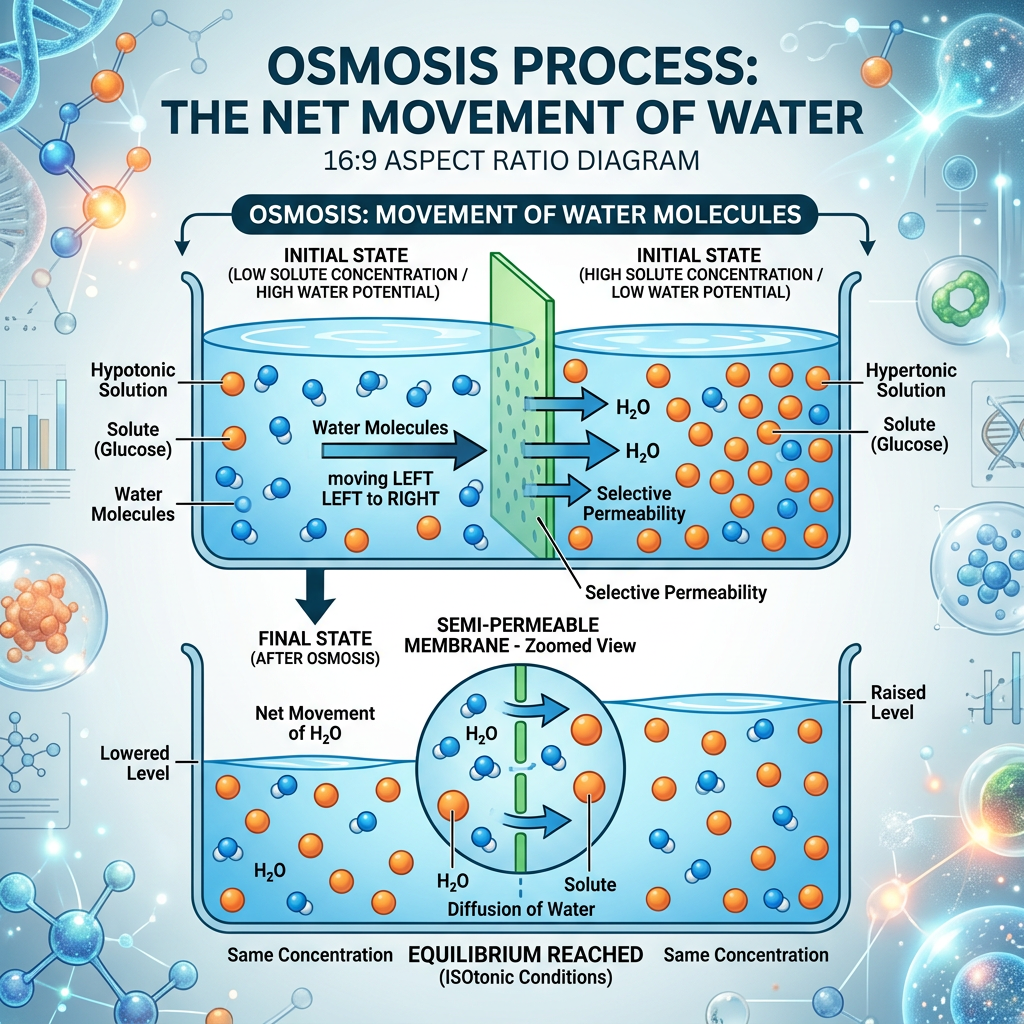
Osmosis is the diffusion of water molecules from a region, where the water molecules are at a higher concentration, to a region where they are at a lower concentration, through a partially permeable membrane.

Illustration of osmosis demonstrating a semi-permeable membrane separating two solutions with different concentrations of particles.

Diffusion vs osmosis:

Osmosis and diffusion are similar in some ways and different in other ways.

OsmosisDiffusion
Osmosis requires a partially permeable membraneDiffusion doesn’t require a partially permeable membrane
Involves water molecules moving from a region of higher water concentration to a region of lower water concentration through a partially permeable membraneInvolves ions, atoms and molecules moving from an area of higher concentration to an area of lower concentration
Occurs in liquids (water)Occurs in solids, liquids and gases
Is a passive process (doesn’t require energy)Is a passive process (doesn’t require energy)
The concentration of the solvent doesn’t become equal on both sides of the partially permeable membrane.The concentration of the diffused molecules becomes distributed equally in a given space.

Plant cells vs animal cells in osmosis:

Diagram illustrating the effects of hypotonic, isotonic, and hypertonic solutions on animal and plant cells. Hypotonic solution shows a lysed animal cell and a turgid plant cell. Isotonic solution shows a normal animal cell and a flaccid plant cell. Hypertonic solution shows a shriveled animal cell and a plasmolyzed plant cell.

When animal cells are placed into solutions with varying solute concentrations, the animal cells will either:

  • expand in size, gain water and eventually burst in distilled water or more dilute (hypotonic) solutions

or

  • lose water and shrink in more concentrated (hypertonic) solutions

With plant cells, they have a cell wall which is strong and prevents the plant cell from bursting.

When plant cells are placed into solutions with varying solute concentrations, the plant cells will either:

  • expand in size, gain water and the vacuole and the cytoplasm will push against the cell wall when the plant cell is placed in distilled water or more dilute (hypotonic) solutions; the plant cell becomes turgid

or

  • lose water and shrink in more concentrated (hypertonic) solutions. The cell contents pull away from the cell wall and the plant cell becomes flaccid.

AQA GCSE Bio Exam questions:

An exam paper page for science students detailing a student's investigation on the effect of salt solution concentrations on uncooked potato mass, including method steps and questions.
A table showing results of an experiment measuring the mass change of potato pieces in various concentrations of salt solution, along with possible apparatus and resolution options.
An exam paper page showing calculations related to changes in mass, data presentation options (bar chart, line graph, pie chart), and fill-in-the-blank sentences about potato cell properties.

Reference:

1.3 Transport in Cells (F) QP.pdf

AQA GCSE Bio Exam answers:

Image of a mark scheme for a science examination question on potato experiments involving transport in cells, detailing guidelines and criteria for grading answers.
A segment of a worksheet on cell transport, listing key concepts related to water, osmosis, and membrane permeability, with specific instructions for answers in a defined range.

Reference:

1.3 Transport in Cells (F) MS.pdf
Categories
Science Revision

The Reactivity Series Explained (GCSE Chemistry)

What the reactivity series is:

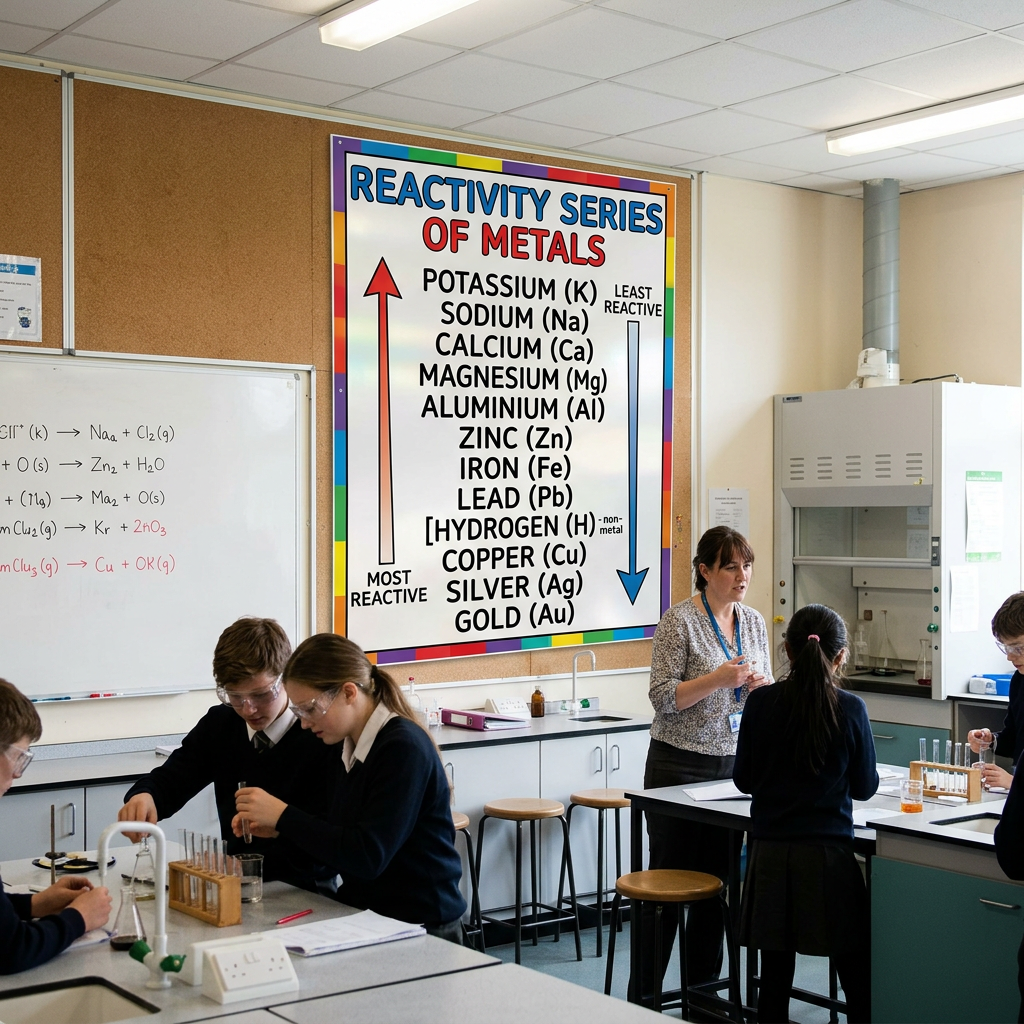
The reactivity series of metals is a chart showing how reactive metals are, with the least reactive metals placed at the bottom of the chart and the most reactive metals placed at the top.

A table outlining the reactivity of various metals with cold water and dilute acids, indicating the reaction types and their reactivity levels from most to least reactive.

Why metals react differently:

The reactivity of a metal is determined by how easily the metal loses electrons; the more easily a metal loses electrons, the higher up it is placed in the Reactivity series table.

Memory tricks for remembering the reactivity series:

There are a variety of ways to remember the reactivity series, one way being the use of mnemonics:

Please Stop Calling Me A Zebra, I Like Her Calling Me Smart Goat

Penguins Swim Like Crazy, Making A Zoo In Cold, Snowy Greenland”

Displacement reactions

Example 1:

For the following reaction, we need to decide if the magnesium and copper atoms swap places when magnesium metal strips are added to a blue copper sulphate solution:

Mg (s) + CuSO₄ (aq) →

magnesium + copper sulfate →

Chart illustrating the reactivity of various metals, with potassium at the top as the most reactive and gold at the bottom as the least reactive.

Since the magnesium is above the copper on the metal reactivity series table, magnesium is more reactive than copper so this means the magnesium atoms (Mg0) release 2 electrons to become completely dissolved in solution and become Mg2+ ions that bond with the water (H2O) and SOâ‚„2- ions while the copper ions (Cu2+) accept the 2 electrons and become copper metal (Cu0) which drops at of solution and forms at the bottom (see the equation below):

Mg (s) + CuSO₄ (aq) → Cu (s) + MgSO₄ (aq)

magnesium + copper sulfate → copper + magnesium sulfate

Additionally, you will start to notice the blue copper sulfate solution starts getting paler when magnesium strips are added to the solution until you get a transparent magnesium sulfate solution.

Example 2:

The following is an example of the highly exothermic Thermite reaction where iron (III) oxide reacts with fine aluminium powder to produce iron and aluminium oxide

Fe2O3 + 2Al → 2Fe + Al2O3

iron(III) oxide + aluminium → iron + aluminium oxide

WARNING: don’t attempt the Thermite experiment unless you have proper scientific lab training, understand the health and safety aspects of this experiment, understand proper chemical disposal procedures, undertaken risk assessments etc.

A vertical chart displaying metals arranged by reactivity, with the most reactive metals listed at the top, including potassium and sodium, and the least reactive, such as lead and copper, at the bottom. The image indicates which metals can be extracted using carbon and which cannot.

This experiment proceeds because iron is below the aluminium in the reactivity series so the aluminium atoms (Al0) lose 3 electrons to become Al3+ and the Fe3+ ions in Fe2O3 accepts the 3 electrons to form iron metal (Fe0). The Fe3+ ions in Fe2O3 are swapped by the Al3+ ions to form Al2O3.

Exam questions:

An examination paper titled 'Reactivity of Metals (F)' with questions related to the reaction between zinc and copper sulfate solution. The first question asks for the type of reaction and includes answer options: combustion, decomposition, and displacement. The second part requires the calculation of the percentage by mass of copper in copper sulfate, providing relative atomic and formula mass values.
A GCSE exam paper question focusing on electrolysis and the extraction of metals, including a table for products of electrolysis and a chemical equation to balance.
A worksheet page showing a chemistry question about calculating the relative formula mass of aluminium oxide (Al2O3) and a reactivity series of metals including potassium, lithium, carbon, zinc, tin, and gold, along with extraction methods.
A worksheet question on displacement reactions, specifically focusing on the extraction of iron from iron oxide using carbon. It includes parts for balancing a chemical equation, explaining the reduction of iron oxide, and calculating the relative formula mass of Fe2O3.
A chemistry exam paper displaying a question about the reactivity of metals, including a chemical reaction involving copper oxide and hydrogen, calculations for percentage atom economy, and an investigation of four different metals by a student.
A table displaying the reactivity results of four metals (A, B, C, D) with various metal sulfate solutions, indicating whether displacement reactions occurred.
An educational worksheet on the reactivity of metals with hydrochloric acid, featuring a diagram (Figure 1) illustrating the rate of bubbling in test tubes labelled A, B, C, and D.

Reference: AQA GCSE Chemistry Topic 4: Chemical Changes Revision – PMT

Exam answers:

A document displaying a mark scheme for a science question, detailing calculations involving displacement, percentage, volume of copper sulfate, mass, temperature change, concentration, line of best fit, and characterizing a reaction as endothermic.
An educational chemistry exam question on the reactivity of metals, including sections on molten compounds, electrolytic products, and calculations related to aluminium oxide.
An examination question page detailing chemical reactions and calculations, including equations, explanations of concepts like oxygen loss, atom economy, and reactivity of metals.
A diagram and text layout for an exam question on reactivity of metals, including pH levels and corresponding universal indicator colours. The layout includes sections labelled (a) to (f), asking for specific chemical reactions and items such as 'neutralisation' and 'burette'.
Categories
Science Revision

Electrolysis Explained for GCSE Students

Definition of electrolysis

Electrolysis is the breaking down of an electrolyte using an applied electric current.

An electrolyte is an ionic substance that has been dissolved in a solvent or has been melted.

Electrolysis of molten compounds

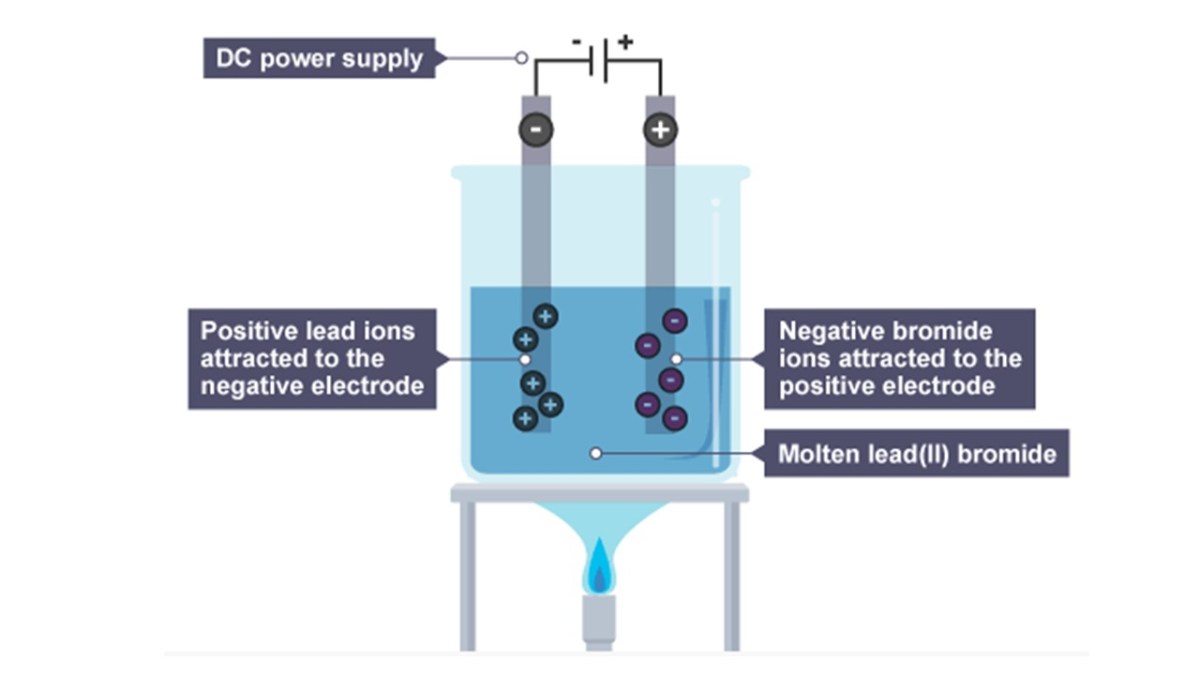
The ionic compound is heated to a very high temperature until it reaches liquid state. The metal cations are positively charged metal ions. They will move towards the negatively charged electrode, called a cathode. These ions become metal atoms at the cathode.

The non-metal anions are negatively charged ions. They will move towards the positively charged electrode, called an anode. These ions become non-metal atoms at the anode.

Fig.1 – electrolysis of molten lead (II) bromide

Diagram showing the electrolysis of molten lead(II) bromide, including a DC power supply, positive lead ions attracted to the negative electrode, and negative bromide ions attracted to the positive electrode.

Electrolysis of aqueous solutions

The ionic compound is dissolved in water. In water, there are H+ and OHions existing and they will compete with the metal cations and non-metal anions.

Fig.2 – electrolysis of aqueous copper sulfate

Diagram illustrating a copper electrolysis setup showing an anode, cathode, and copper(II) sulphate solution, with reactions for oxygen gas production and copper metal deposition.

Half-equations explained

To figure out what is produced at the cathode (negative electrode) and at the anode (positive electrode), follow the two rules below:

Rule 1: At the cathode, check the reactivity of the metal ion. If it is more reactive than hydrogen, the hydrogen ions are reduced to form a hydrogen molecule.

Chart showing metals arranged by reactivity, from most reactive potassium at the top to least reactive gold at the bottom.

Rule 2: At the anode, the anions are oxidised in the following order:

Halide ion > hydroxide ion > all other negatively charged ions

Table showing negative ions from electrolytes and the corresponding elements released at the anode.

If there are no halide ions present to be oxidised at the anion, then the hydroxide ions are next to be oxidised and the following half-equation describes what happens to the hydroxide ion that is oxidised at the anode:

4OH→ 2H2O + O2 + 4e

Practice questions

A worksheet on electrolysis and metal extraction, featuring multiple choice and table completion questions about molten substances, electrode products, and balancing a chemical equation.
A chemistry exam question focusing on the calculation of the relative formula mass of aluminium oxide and a diagram illustrating the reactivity series of metals, including potassium, lithium, carbon, zinc, tin, and gold, with instructions for predicting extraction methods.

Source for Questions papers and Answers:

AQA GCSE Chemistry Topic 4: Chemical Changes Revision – PMT

Answers to practice questions:

A mark scheme for an exam question on electrolysis, detailing the movement of ions, products at electrodes, and calculations related to electrochemical processes.
Categories
Science Revision

Thoughts on The Power of Now by Eckhart Tolle

Too much thinking on the Past and I become sad and regretful. Too much thinking on the Future that may come and I become anxious and unfulfilled over not reaching that potential. In both cases, I become identified with my Mind/ my Ego which is linked to and relates to Time. To live in the Now, to live in the Present, is to silence the Mind/ the Ego, is to Be in the moment which is happiness. – from the book, The Power of Now

PS – too much thinking in the Now would mean I become reactive, not proactive which means I don’t work towards my Goals (my overarching goals coming from my identity) and Life becomes meaningless. So I must think mostly in the Now while taking lessons from the Past and using the Future-thinking briefly to guide my progress in the Now to achieve my Goals.

I include in this blog post the Amazon link to further browse and purchase the book, ‘The Power of Now’ by Eckhart Tolle if you liked reading my summary. I highly recommend it.

Categories
Science Revision

Know thyself

30 years of my life it has taken me to realise the hidden wisdom within that cryptic saying “know Thyself” by Socrates thousands of years ago. Knowing who you are means you know what your personality is and if it is suitable for the job you will be doing for the rest of your life; if you are an introvert, you will not enjoy doing work where you must and need to entertain and socialise with your clients to generate business compared to someone whose hobby usually involves partying a lot. Knowing who you are determines what your vision is for the future and it is that future that determines who will want to stay in your life whether a spouse, friend, business partner etc. People diverge from each other in life because of circumstances and because their vision of what they want in life, determined by who they are, conflict.

I learned this from Myles Munroe and a Facebook friend.

Categories
Science Revision

Abundance mentality vs scarcity mentality

Abundance mentality vs scarcity mentality

One is aggressive/ proactive, the other is passive/ reactive.
One plays to win no matter the cost, the other plays to survive and makes excuses.

Abundance MentalityAbundance and Scarcity Mindset

Categories
Science Revision

“Better to be Socrates dissatisfied than a fool satisfied”

“It is better to be a human being dissatisfied than a pig satisfied; better to be Socrates dissatisfied than a fool satisfied”; I finally understand the meaning behind this quote.
From the quote, I am getting the idea that Socrates/ the human being wanted to fully realise/ achieve their wishes and dreams which would have had a greater impact on humanity (in terms of progression of ideas) but Socrates/ the human being failed realising that desire or wish. However, in that failure, at least it brought them closer to their goal. In contrast, the pig/ the fool only pursues short term wishes/ happiness , never thinking about the future or the progress of Humanity.
However, it also shows that pursuing pleasure is graded; there are the base pleasures which are short-term and eventually lead to ruin while there are the higher pleasures, more abstract and intellectual, that lead to the benefit of the thinker and for society.