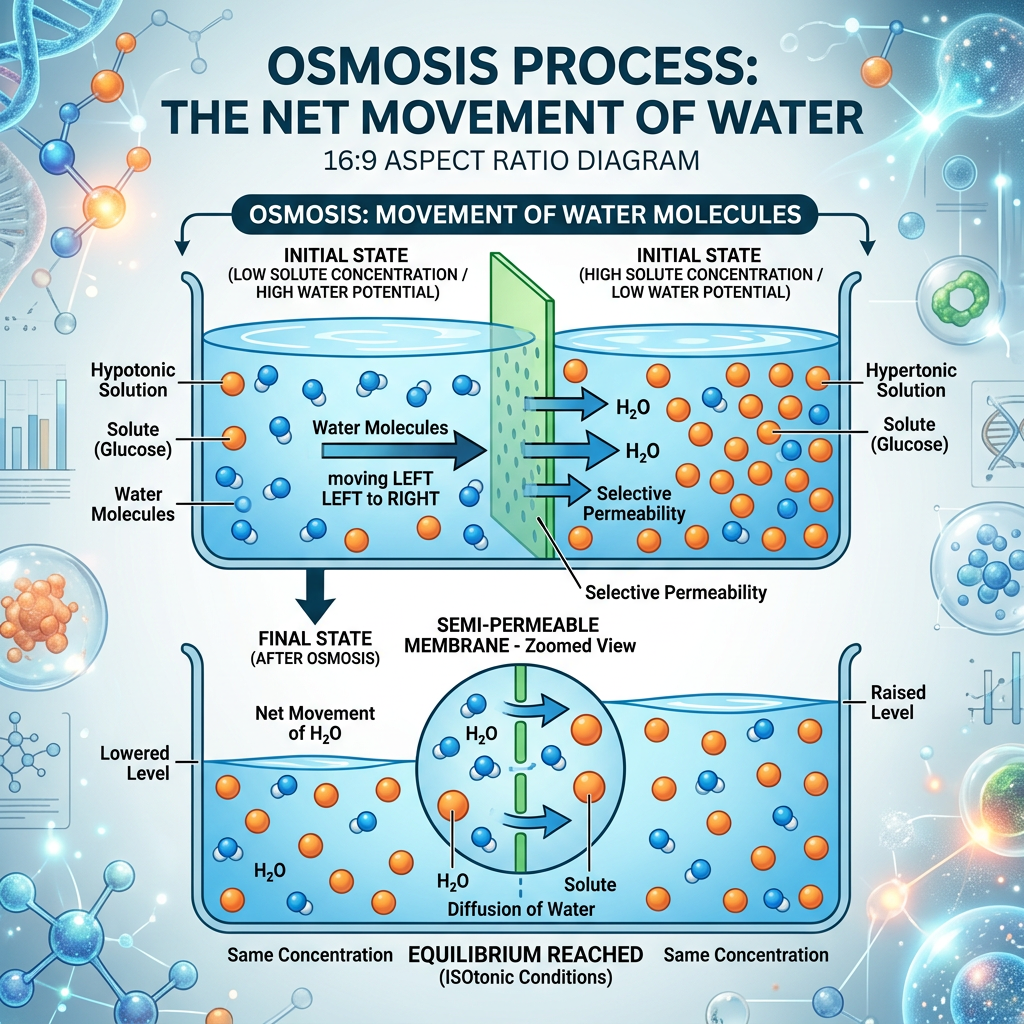
Definition of osmosis:
Osmosis is the diffusion of water molecules from a region, where the water molecules are at a higher concentration, to a region where they are at a lower concentration, through a partially permeable membrane.

Diffusion vs osmosis:
Osmosis and diffusion are similar in some ways and different in other ways.
| Osmosis | Diffusion |
| Osmosis requires a partially permeable membrane | Diffusion doesn’t require a partially permeable membrane |
| Involves water molecules moving from a region of higher water concentration to a region of lower water concentration through a partially permeable membrane | Involves ions, atoms and molecules moving from an area of higher concentration to an area of lower concentration |
| Occurs in liquids (water) | Occurs in solids, liquids and gases |
| Is a passive process (doesn’t require energy) | Is a passive process (doesn’t require energy) |
| The concentration of the solvent doesn’t become equal on both sides of the partially permeable membrane. | The concentration of the diffused molecules becomes distributed equally in a given space. |
Plant cells vs animal cells in osmosis:

When animal cells are placed into solutions with varying solute concentrations, the animal cells will either:
- expand in size, gain water and eventually burst in distilled water or more dilute (hypotonic) solutions
or
- lose water and shrink in more concentrated (hypertonic) solutions
With plant cells, they have a cell wall which is strong and prevents the plant cell from bursting.
When plant cells are placed into solutions with varying solute concentrations, the plant cells will either:
- expand in size, gain water and the vacuole and the cytoplasm will push against the cell wall when the plant cell is placed in distilled water or more dilute (hypotonic) solutions; the plant cell becomes turgid
or
- lose water and shrink in more concentrated (hypertonic) solutions. The cell contents pull away from the cell wall and the plant cell becomes flaccid.
AQA GCSE Bio Exam questions:


Reference:
1.3 Transport in Cells (F) QP.pdf
AQA GCSE Bio Exam answers:


Reference:
1.3 Transport in Cells (F) MS.pdf
Leave a Reply