Categories
Science Revision

Osmosis Explained Simply (GCSE Biology)

Definition of osmosis:

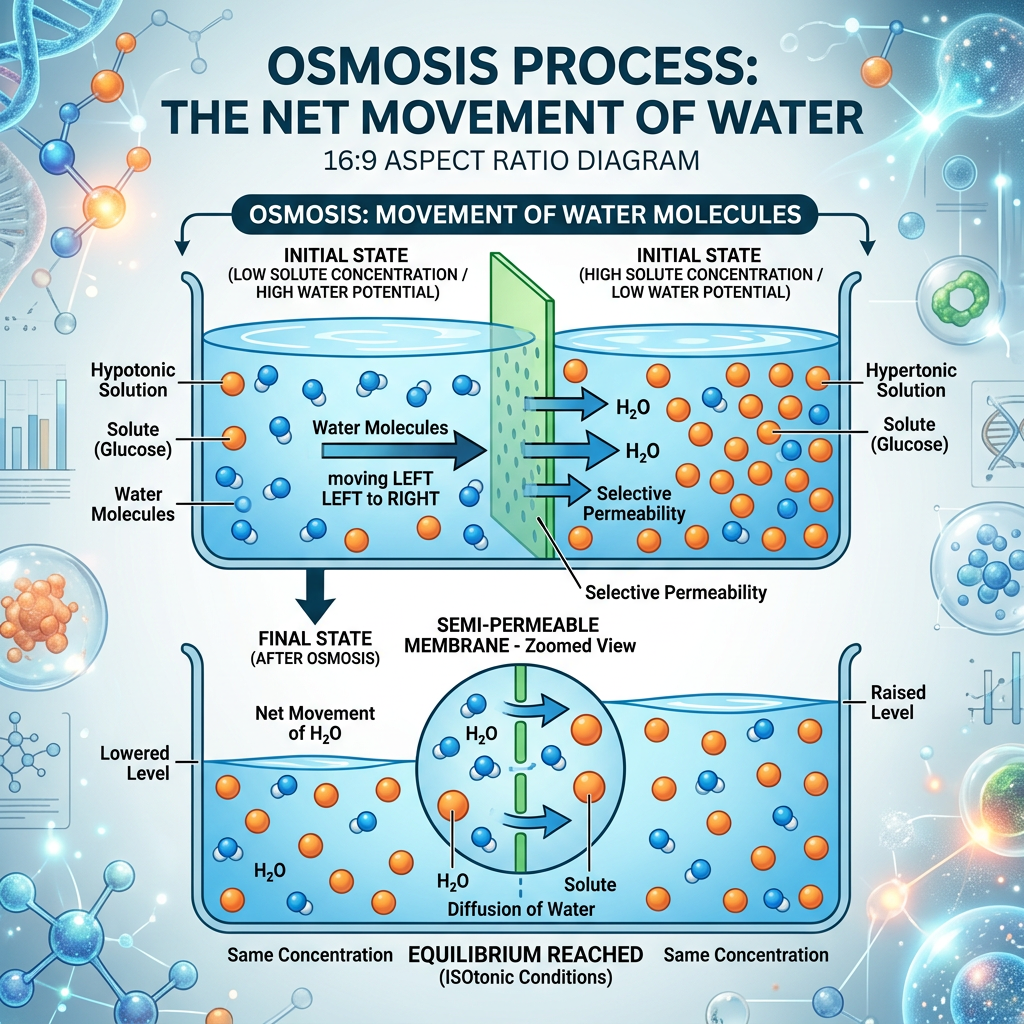
Osmosis is the diffusion of water molecules from a region, where the water molecules are at a higher concentration, to a region where they are at a lower concentration, through a partially permeable membrane.

Illustration of osmosis demonstrating a semi-permeable membrane separating two solutions with different concentrations of particles.

Diffusion vs osmosis:

Osmosis and diffusion are similar in some ways and different in other ways.

OsmosisDiffusion
Osmosis requires a partially permeable membraneDiffusion doesn’t require a partially permeable membrane
Involves water molecules moving from a region of higher water concentration to a region of lower water concentration through a partially permeable membraneInvolves ions, atoms and molecules moving from an area of higher concentration to an area of lower concentration
Occurs in liquids (water)Occurs in solids, liquids and gases
Is a passive process (doesn’t require energy)Is a passive process (doesn’t require energy)
The concentration of the solvent doesn’t become equal on both sides of the partially permeable membrane.The concentration of the diffused molecules becomes distributed equally in a given space.

Plant cells vs animal cells in osmosis:

Diagram illustrating the effects of hypotonic, isotonic, and hypertonic solutions on animal and plant cells. Hypotonic solution shows a lysed animal cell and a turgid plant cell. Isotonic solution shows a normal animal cell and a flaccid plant cell. Hypertonic solution shows a shriveled animal cell and a plasmolyzed plant cell.

When animal cells are placed into solutions with varying solute concentrations, the animal cells will either:

  • expand in size, gain water and eventually burst in distilled water or more dilute (hypotonic) solutions

or

  • lose water and shrink in more concentrated (hypertonic) solutions

With plant cells, they have a cell wall which is strong and prevents the plant cell from bursting.

When plant cells are placed into solutions with varying solute concentrations, the plant cells will either:

  • expand in size, gain water and the vacuole and the cytoplasm will push against the cell wall when the plant cell is placed in distilled water or more dilute (hypotonic) solutions; the plant cell becomes turgid

or

  • lose water and shrink in more concentrated (hypertonic) solutions. The cell contents pull away from the cell wall and the plant cell becomes flaccid.

AQA GCSE Bio Exam questions:

An exam paper page for science students detailing a student's investigation on the effect of salt solution concentrations on uncooked potato mass, including method steps and questions.
A table showing results of an experiment measuring the mass change of potato pieces in various concentrations of salt solution, along with possible apparatus and resolution options.
An exam paper page showing calculations related to changes in mass, data presentation options (bar chart, line graph, pie chart), and fill-in-the-blank sentences about potato cell properties.

Reference:

1.3 Transport in Cells (F) QP.pdf

AQA GCSE Bio Exam answers:

Image of a mark scheme for a science examination question on potato experiments involving transport in cells, detailing guidelines and criteria for grading answers.
A segment of a worksheet on cell transport, listing key concepts related to water, osmosis, and membrane permeability, with specific instructions for answers in a defined range.

Reference:

1.3 Transport in Cells (F) MS.pdf

Categories
Uncategorized

Quantum computing

Quantum computing is a new type of computing that uses the rules of quantum physics to process information in ways that traditional computers can’t.

Classical vs. quantum computers

  • Classical computers (laptops, phones) use bits that are either 0 or 1.
  • Quantum computers use qubits, which can be 0, 1, or both at the same time (a property called superposition).

Key ideas (in simple terms)

Superposition: A qubit can represent multiple possibilities at once, allowing many calculations to be explored simultaneously. To understand superposition in a simple way, let’s imagine a person on a ladder [ref. 1]; a person further up the ladder would have a higher potential energy than if they were much closer to the ground. However, unlike the person on a ladder example, atoms can possess more than one energy state simultaneously so the atom would behave like a person who is both occupying the ladder closer to the ground and also further up the ladder. Hence, the atom that is in this mixed energy state is known as “quantum superposition”. [see ref. 1]

Fig 1 – shows superposition in the qubit particle (represented by the sphere) [source ref. 1]

Entanglement: Qubits can become linked so that changing one instantly affects another, even if they’re far apart like if one qubit was placed on the Moon and another qubit was placed on Earth [source ref. 1]

Fig 2 – shows quantum entanglement between two qubit particles (each qubit particle represented by a sphere) [see ref. 1]

Quantum interference: The computer amplifies correct answers and cancels out wrong ones through carefully designed operations. Interference arises because of the wave-like properties of quantum particles like electrons and photons (a photon being a packet of energy of electromagnetic radiation, [see ref. 2 and 3]). When a particle is in a superposition of multiple states, these states can interact with each other that can lead to constructive or destructive interference [see ref. 2].

Fig 3 – shows constructive wave interference on the left and destructive wave interference on the right [see ref. 4]

Why this matters

Because of these properties, quantum computers can solve certain problems much faster than classical computers, such as:

  • Breaking or analyzing some types of encryption
  • Simulating molecules and materials (useful in medicine and chemistry)
  • Optimizing complex systems (like logistics or traffic flow)

Important limitations

  • Quantum computers are not faster at everything.
  • They are very hard to build and control.
  • Current quantum computers are experimental and prone to errors.

Simple analogy

If a classical computer checks solutions one at a time, a quantum computer explores many paths at once, then uses physics to guide itself toward the best answer.

Bottom line

Quantum computing doesn’t replace regular computers. Instead, it’s a powerful new tool designed to tackle specific problems that are extremely difficult or impossible for today’s machines.

Reference:

  1. https://www.nist.gov/quantum-information-science/quantum-computing-explained
  2. https://quantum.microsoft.com/en-us/insights/education/concepts/interference
  3. https://www.britannica.com/science/light
  4. https://kids.britannica.com/students/assembly/view/53869