Categories
Uncategorized

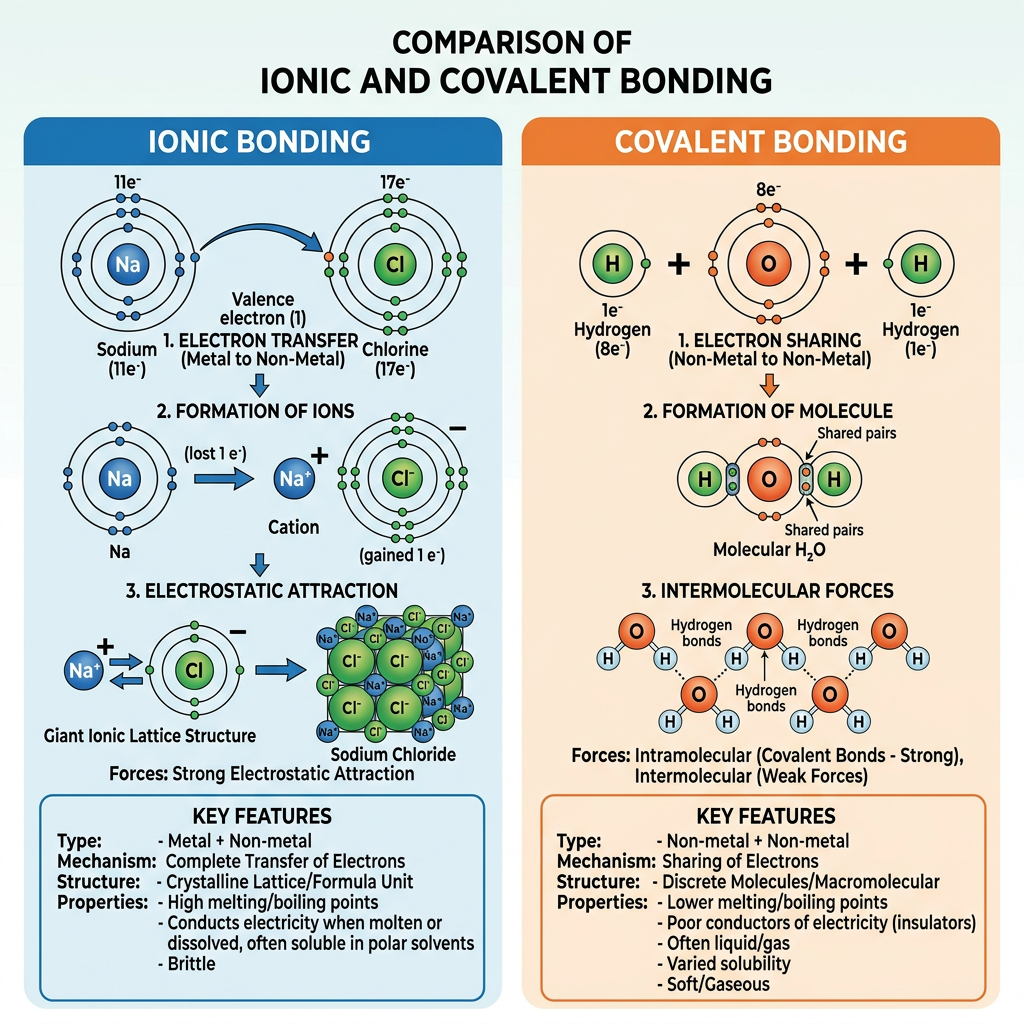
Ionic vs Covalent bonding Explained

What is ionic bonding?

Ionic bonding is the strong electrostatic force of attraction between oppositely charged ions. Ions are formed when atoms gain electrons or lose electrons.

When atoms gain electrons, they become negatively charged particles or ions; these ions are called anions.

When atoms lose electrons, they become positively charged particles or ions; these ions are called cations.

Fig.1 – diagram shows ionic bond formation between Lithium and Fluorine ions. The Lithium ion forms when the Lithium atom loses 1 electron. This electron is given to the Fluorine atom. As a result, the Fluorine atom becomes a Fluorine ion.

Illustration showing the formation of lithium fluoride (LiF) from lithium (Li) and fluorine (F) atoms. The top section depicts the atomic structure of Li and F, while the bottom section displays the resulting Li+ and F- ions.

What is covalent bonding?

A covalent bond is formed when two non-metal atoms share a pair of electrons. The shared electrons would usually be in the outer shells of the atoms.

Fig.2 – diagram shows covalent bond formation between two hydrogen atoms where each hydrogen atom shares a pair of electrons. A hydrogen molecule, H2 , is formed.

Diagram illustrating the formation of a hydrogen molecule (H2) from two hydrogen atoms, showing atomic structure and bonding.

Key differences between ionic and covalent bonding

Comparison table of ionic and covalent bonding characteristics.

Practice questions

A worksheet page from a chemistry resource discussing methane and buckminsterfullerene, with questions about their properties and structure.
An educational image showing the structure of graphite with carbon atoms linked in a diagrammatic form and a question about the number of covalent bonds each carbon atom forms.
Diagram illustrating the crystal structure of diamond, showing carbon atoms and their bonding arrangement.
An examination sheet featuring questions about carbon and its compounds, with diagrams labelled A, B, C, and D representing different carbon structures such as graphite and poly(ethene). Figure 2 depicts the structure of diamond, with carbon atoms illustrated in a specific arrangement.
A science exam question asking students to describe the reaction between magnesium and oxygen, specifically referencing electrons.

Reference link:

2.1 Chemical Bonds – Ionic, Covalent and Metallic (F) QP.pdf

Practice answers

A mark scheme for a chemistry exam covering ionic, covalent, and metallic bonds, detailing answers for various questions.
An exam question sheet on chemical bonds, featuring multiple-choice options and calculations related to ionic, covalent, and metallic bonds.
Diagram explaining ionic bonding, focusing on magnesium losing electrons and oxygen gaining electrons to form ions.

Reference link:

2.1 Chemical Bonds – Ionic, Covalent and Metallic (F) MS.pdf

Leave a Reply

Discover more from www.intellectualthinking.com

Subscribe now to keep reading and get access to the full archive.

Continue reading