Categories
Science Revision

The Reactivity Series Explained (GCSE Chemistry)

What the reactivity series is:

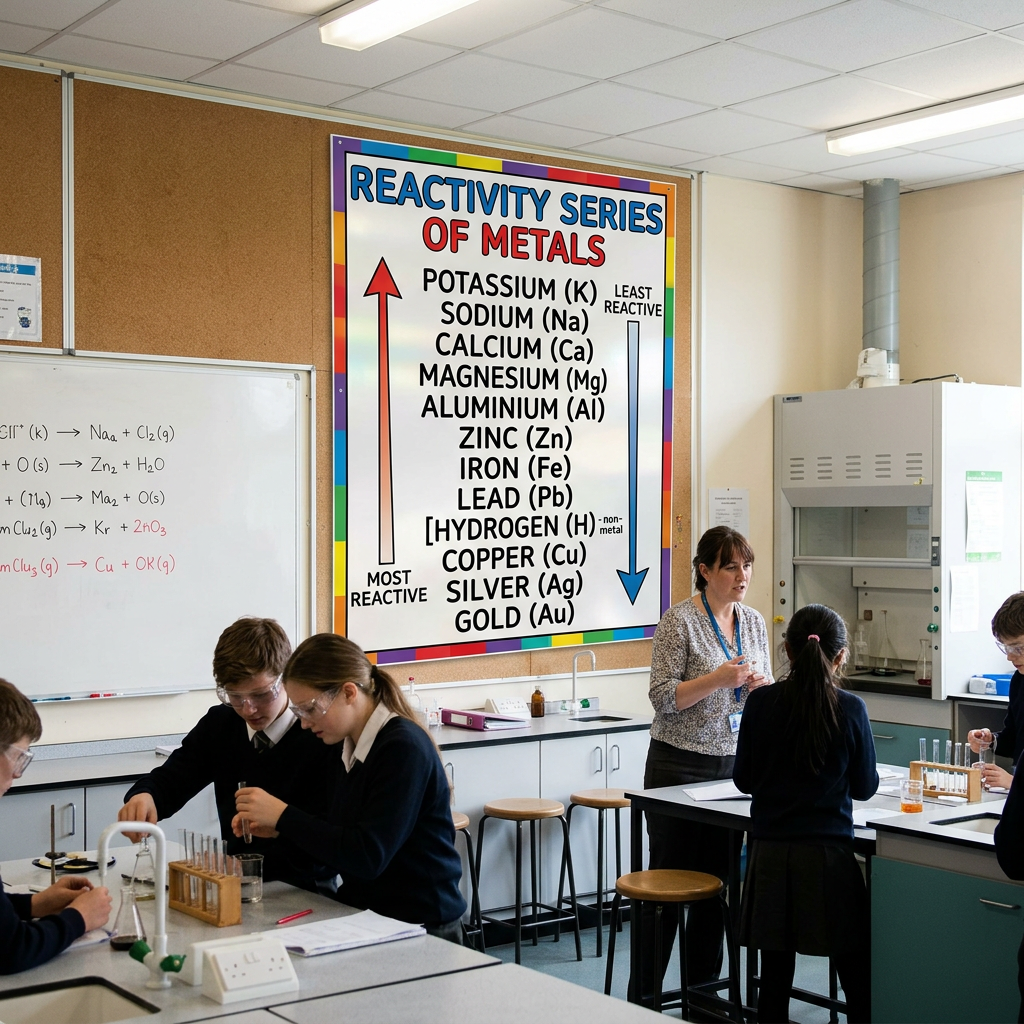
The reactivity series of metals is a chart showing how reactive metals are, with the least reactive metals placed at the bottom of the chart and the most reactive metals placed at the top.

A table outlining the reactivity of various metals with cold water and dilute acids, indicating the reaction types and their reactivity levels from most to least reactive.

Why metals react differently:

The reactivity of a metal is determined by how easily the metal loses electrons; the more easily a metal loses electrons, the higher up it is placed in the Reactivity series table.

Memory tricks for remembering the reactivity series:

There are a variety of ways to remember the reactivity series, one way being the use of mnemonics:

Please Stop Calling Me A Zebra, I Like Her Calling Me Smart Goat

Penguins Swim Like Crazy, Making A Zoo ICold, Snowy Greenland”

Displacement reactions

Example 1:

For the following reaction, we need to decide if the magnesium and copper atoms swap places when magnesium metal strips are added to a blue copper sulphate solution:

Mg (s) + CuSO₄ (aq) →

magnesium + copper sulfate →

Chart illustrating the reactivity of various metals, with potassium at the top as the most reactive and gold at the bottom as the least reactive.

Since the magnesium is above the copper on the metal reactivity series table, magnesium is more reactive than copper so this means the magnesium atoms (Mg0) release 2 electrons to become completely dissolved in solution and become Mg2+ ions that bond with the water (H2O) and SO₄2- ions while the copper ions (Cu2+) accept the 2 electrons and become copper metal (Cu0) which drops at of solution and forms at the bottom (see the equation below):

Mg (s) + CuSO₄ (aq) → Cu (s) + MgSO₄ (aq)

magnesium + copper sulfate → copper + magnesium sulfate

Additionally, you will start to notice the blue copper sulfate solution starts getting paler when magnesium strips are added to the solution until you get a transparent magnesium sulfate solution.

Example 2:

The following is an example of the highly exothermic Thermite reaction where iron (III) oxide reacts with fine aluminium powder to produce iron and aluminium oxide

Fe2O3 + 2Al → 2Fe + Al2O3

iron(III) oxide + aluminium → iron + aluminium oxide

WARNING: don’t attempt the Thermite experiment unless you have proper scientific lab training, understand the health and safety aspects of this experiment, understand proper chemical disposal procedures, undertaken risk assessments etc.

A vertical chart displaying metals arranged by reactivity, with the most reactive metals listed at the top, including potassium and sodium, and the least reactive, such as lead and copper, at the bottom. The image indicates which metals can be extracted using carbon and which cannot.

This experiment proceeds because iron is below the aluminium in the reactivity series so the aluminium atoms (Al0) lose 3 electrons to become Al3+ and the Fe3+ ions in Fe2O3 accepts the 3 electrons to form iron metal (Fe0). The Fe3+ ions in Fe2O3 are swapped by the Al3+ ions to form Al2O3.

Exam questions:

An examination paper titled 'Reactivity of Metals (F)' with questions related to the reaction between zinc and copper sulfate solution. The first question asks for the type of reaction and includes answer options: combustion, decomposition, and displacement. The second part requires the calculation of the percentage by mass of copper in copper sulfate, providing relative atomic and formula mass values.
A GCSE exam paper question focusing on electrolysis and the extraction of metals, including a table for products of electrolysis and a chemical equation to balance.
A worksheet page showing a chemistry question about calculating the relative formula mass of aluminium oxide (Al2O3) and a reactivity series of metals including potassium, lithium, carbon, zinc, tin, and gold, along with extraction methods.
A worksheet question on displacement reactions, specifically focusing on the extraction of iron from iron oxide using carbon. It includes parts for balancing a chemical equation, explaining the reduction of iron oxide, and calculating the relative formula mass of Fe2O3.
A chemistry exam paper displaying a question about the reactivity of metals, including a chemical reaction involving copper oxide and hydrogen, calculations for percentage atom economy, and an investigation of four different metals by a student.
A table displaying the reactivity results of four metals (A, B, C, D) with various metal sulfate solutions, indicating whether displacement reactions occurred.
An educational worksheet on the reactivity of metals with hydrochloric acid, featuring a diagram (Figure 1) illustrating the rate of bubbling in test tubes labelled A, B, C, and D.

Reference: AQA GCSE Chemistry Topic 4: Chemical Changes Revision – PMT

Exam answers:

A document displaying a mark scheme for a science question, detailing calculations involving displacement, percentage, volume of copper sulfate, mass, temperature change, concentration, line of best fit, and characterizing a reaction as endothermic.
An educational chemistry exam question on the reactivity of metals, including sections on molten compounds, electrolytic products, and calculations related to aluminium oxide.
An examination question page detailing chemical reactions and calculations, including equations, explanations of concepts like oxygen loss, atom economy, and reactivity of metals.
A diagram and text layout for an exam question on reactivity of metals, including pH levels and corresponding universal indicator colours. The layout includes sections labelled (a) to (f), asking for specific chemical reactions and items such as 'neutralisation' and 'burette'.